

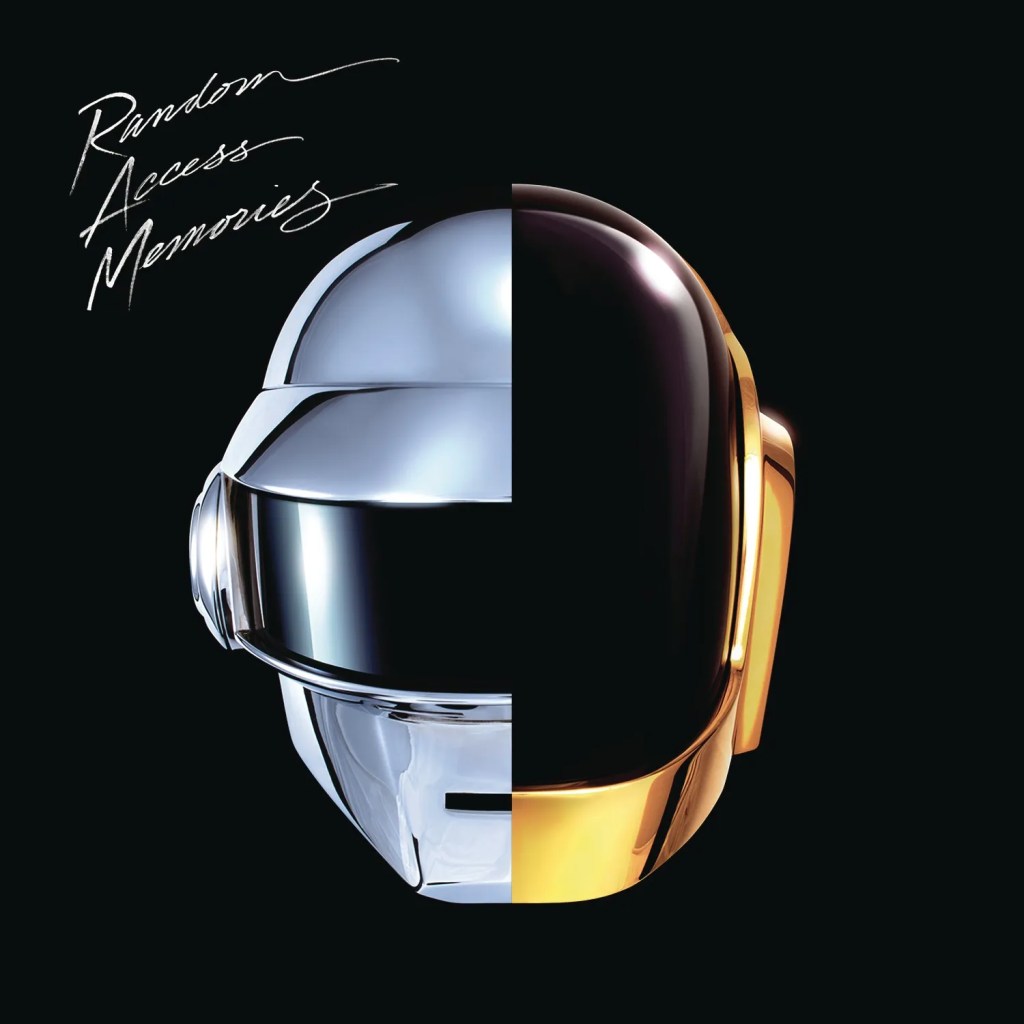
The release of Daft Punk’s “Random Access Memories” (RAM) in 2013 by French duo Thomas Bangalter and Guy-Manuel, marked a transformative shift in the music production landscape. This case study will delve into the intricacies of RAM’s production, focusing on the critical listening, technical and professional skills demanded of primary audio engineer Mick Guzauski. We will also explore how advancements in sound capture and playback technology have influenced Guzauski’s methodologies in the creation of this album. Daft Punk enlisted an extensive production crew, orchestra, featured artists and additional musicians in the creation of RAM, a project for which they dedicated “four years and over a million dollars on” (Tingen, P. 2023). RAM was meticulously crafted through recording sessions held at three different studios in California, along with additional sessions in both New York City and Paris.
RAM marked a departure from the prevailing electronic dance music (EDM) trend, embracing a return to the pre-digital age ethos of disco with the goal of being “still dance, still electronic, but giv[ing] that human touch back” (Wilson, G. 2013). One way in which Guzauski achieved this was through the sampling of real drums instead of the traditional use of drum machines typical in EDM. The utilisation of this playback technology required Guzauski and Daft Punk to adopt a unique approach when recording with drummer Omar Hakim. By making Hakim perform individual patterns for extended periods of time, Guzauski was able to create an extensive library for the duo to cull from. As Hakim emphasised, “Normally in a recording session you learn a song and you play it from top to bottom” (Batchelor, L. 2013). Daft Punk, deviated from this norm by sampling Hakim’s drumming using “riff ideas that were only four bars or eight bars long,” encouraging him to jam on them “for five to ten minutes” (Batchelor, L. 2013). In this innovative process Guzauski and Daft Punk used critical listening skills to carefully discern which samples to use in specific bars, ensuring that the chosen elements seamlessly complemented each other. Moreover, technical skills were crucial in the assembly of these samples, requiring the ability to put them together without creating abrupt transitions when moving from one sample to another. Similarly, Daft Punk sampled pianist Chilly Gonzales and composer Giorgio Moroder also known as the ‘Father of Disco’. Gonzales was made to improvise on ideas that the duo would hum to him whilst Moroder’s voice was sampled during an interview of his life story and used on the song ‘Giorgio Moroder’.
Daft Punk not only sought sampled drums but also desired “a tight seventies kind of disco” tone that was “sort of dead” (Puremix. 2020). To achieve this Guzauski manipulated room acoustics by utilising mics “angled back a little bit into the dead area” and “a pair [of] 67’s or 87’s out in the room” (Puremix. 2020). The kick drum recording, crucial to the album’s rhythm, involved the use of four microphones (AKG D112, Sony C-500, Neumann U47, and a Yamaha Subkick), showcasing Guzauski’s nuanced technical skills. This provided Daft Punk with a range of EQ and sound options for their experimentation and creative exploration as well as the flexibility to choose between a “really tight drum sound” or “room and ambience” (Puremix. 2020). When contrasting this innovative approach with traditional ’70s drum micing techniques, a larger emphasis is placed on keeping overhead mics “lower than we hang them today” (Haines, G. 2021). ’70s engineers also often prioritised actions like “deadening the snare head” and removing the “bass drum’s front head” (Haines, G. 2021) to achieve distinct tones, yet these practices limit the creative control of the drum’s ambient qualities. Gauzauski wanted the option “to go anywhere with the drum sound” (Puremix. 2020) which is why he opted for a unique microphone placement that captured both sonic qualities. Furthermore, Guzauski’s deliberate choice of the Neumann U 67 and 87 microphone, developed in 1960 and 1967, underscores his acute ability to discern the nuances between microphones and appreciate how these distinctions might impact the listener’s experience. This is evident in the response of Giorgio Moroder’s inquiry about the relevance of such choices: “Oh, they hear the difference” (Biraghi, M. 2020).
The creation of Daft Punk’s RAM involved a fusion of historical analogue techniques with modern digital tools. Recording into Pro Tools was followed by a conversion to tape, ensuring that it could be “mixed back into the Pro Tools session” (Weiner, J. 2018) for precise editing. This meant that Guzauski had the option of either choosing between “whether the softer sound and the rounder bigger bottom of the analogue really fitted, or the clarity of the digital fitted” (Pensado’s Place. 2013). Guzauski also notes that “every mix was printed three times” (Puremix. 2020) at different dB levels, on three Ampex ATRs with distinct mechanical features changed with each machine. This process yielded a total of “nine prints for each song” (Puremix. 2020) in the 12-track album. The term “printing” refers to the act of transferring a mix onto a physical medium which in the context of RAM allowed Guzauski to create mixes with different sonic characteristics to later be assessed and compared. It is also worth noting that these prints were also recorded in DSD (Direct Stream Digital) format for listening and archival purposes. DSD is a digital audio format released in 1999, characterised by a “very high sampling rate: 64 times the CD audio sampling rate” (Uknown. 2023). Guzauski reflects on this, stating that DSD “was the best sounding one,” but he was “overridden” by the duo that opted for analogue, which “had a character that was just perfect for the album” (Puremix. 2020). This demonstrates Guzauski’s professional skills, particularly his adaptability and ability to collaborate with the duo. Moreover, his acceptance of the duo’s preference for analogue, despite his inclination towards DSD, highlights his professionalism and commitment to realising their artistic vision. Lastly his ability to print mixes at varying dB levels and across different machines showcases his technical proficiency.
Prior to creating the prints for RAM’s songs, Guzauski undertook the rigorous task of mixing and automating on a “72-input analogue console” (Gallant, M. n.d.). Whilst audio editor David Channing and Daft Punk were responsible for “editing large amounts of tracks and making them groove together” (Weiner, J. 2018) in Pro Tools, Guzauski had the responsibility “to listen to each one and mix each instrument from the analogue source” (MusicTech. 2018). The historical process of “console automation began around 1973”, and some believe that even earlier 8-channel systems were used at “Motown in 1966” (Burgess, R. 2014. pg.100). Notably “in 1988, Neve debuted its completely new ‘Flying Faders’ system” (Burgess, R. 2014. pg.101) enhancing the efficiency and accuracy of the mixing process. Though Guzauski would have significantly benefited from such advancements in playback technology, songs such as the 250-track complexity of ‘Touch’ still proved to be a formidable challenge in mixing large-scale sessions. Guzauski reflects on this by acknowledging that “in some cases this involved some submixing in the box to bring it down to 72 Pro Tools outputs or less” (Weiner, J. 2018) as often we “had more tracks than faders” (Gallant, M. n.d.). The mention of “submixing in the box” refers to the process of combining multiple audio tracks within the DAW Pro Tools, demonstrating a smooth integration of digital tools within the analogue workflow. Guzauski’s intricate interplay of technical expertise and professional skills are apparent within both his mixing process and collaboration with the duo as highlighted by the quote: “Thomas and Guy-Man would regularly come in and comment, and I’d work on the mix some more” (Weiner, J. 2018). Furthermore, his use of critical listening skills whilst mixing is evident in the statement: “I’d then listen to the whole thing quickly, and then I’d listen to each track” (Weiner, J. 2018).
The impact of modern-day digital tools was vital in the creation of RAM. Phrases such as “they took the Pro Tools files back to France” (Weiss, D. 2017) and “the new songs came together around the world,” (Weiner, J. 2018) illustrate the impact that contemporary technology had on the collaborative process of this album. The ability to transport files between international locations was undeniably a key feature in the creation of RAM. As Thomas Bangalter of Daft Punk pointed out, “today, electronic music is made in airports and hotel rooms, by DJs traveling” (Weiner, J. 2018). Guzauski’s ability to adapt in the ever-evolving music production landscape demonstrates his technical skills and his keen understanding of music creation. As previously mentioned, Guzauski used a lot of analogue technology as “Daft Punk didn’t want to process digitally” (Gallant, M. n.d.). Guzauski limited his use of EQ, noise gates and compression as he wanted to achieve a “natural sound” (Haines, G. 2021). Guzauski states that he used “mostly vintage effects” (Pensado’s Place. 2013) with a few digital reverbs, a digital “UAD Precision De-Esser” and a “digital delay” but “that’s pretty much it” (Gallant, M. n.d.). This approach aligns with Daft Punk’s preference for an analogue aesthetic, emphasising Guzauski’s meticulous adherence to their sonic vision.
Mick Guzauski’s integral role in Daft Punk’s RAM exemplifies his technical, critical listening, and professional skills. His impressive use of analogue and digital tools, inventive sampling techniques, innovative drum micing techniques and old-school microphone selection showcase his dedication to foresee Daft Punk’s vision amid the ever-evolving music production landscape. Guzauski’s collaboration in an international production context further highlights his ability to adapt to new technologies with a sense professionalism and commitment to achieving Daft Punk’s desired sonic outcome. In essence, RAM stands as a groundbreaking album that merges historical techniques with modern technology, departing from prevailing trends while reviving the essence of 1970’s disco. Guzauski’s multifaceted skills and collaborative spirit played a pivotal role in shaping the album’s distinctive sound, leaving an indelible mark on contemporary music production.
Bibliography
Batchelor, LaRon. (2013, December 20) Drummer Omar Hakim: Getting lucky with daft punk & stevie wonder by Laron Batchelor. YouTube. https://youtu.be/eA6kzUqT4zM?si=lEirtzqGoh1s-knu
Biraghi, M. (2020, November 13). The importance of details: Daft Punk’s Random Access Memories. Beat Spot. https://www.beatspot.pro/blogs/blog/the-importance-of-details-daft-punks-random-access-memories
Burgess, R. (28 August 2014).The history of music production. The History of Music Production. Oxford University Press. https://global.oup.com/ukhe/product/the-history-of-music-production-9780199357178
Gallant, M. (n.d.) Mick Guzauski on Mixing Daft Punk’s random access memories with Universal Audio: Universal Audio. Mick Guzauski On Mixing Daft Punk’s Random Access Memories with Universal Audio | Universal Audio. https://www.uaudio.com/blog/artist-interview-mick-guzauski/
Haines, G. (2021, October 20). 70s drum sound – how to recreate. DRUM! Magazine. https://drummagazine.com/how-to-recreate-drum-sounds-of-the-1970s/
Mason, K. (2013, May 10). Daft punk: How the pioneering dance duo conjured “random access memories.” Billboard. https://www.billboard.com/music/music-news/daft-punk-how-the-pioneering-dance-duo-conjured-random-access-memories-1561328/
MusicTech (April 07, 2018) Recording spotlight: Daft punk – random access memories. MusicTech. https://musictech.com/features/recording-spotlight-random-access-memories/
Pensado’s Place. (2013, May 18). Mix engineer Mick Guzauski – Pensado’s place #115. YouTube. https://www.youtube.com/watch?source_ve_path=Mjg2NjQsMTY0NTAz&feature=emb_share&v=aKmvfgCILHg
Puremix. (2020, May 18) Recording + mixing: Mick Guzauski stories on daft punk random access memories. YouTube. https://youtu.be/hsarcAAQDaw?si=gobzLFUpqUfoR1xD
Richardson, M. (n.d.). Daft punk: Random access memories. Pitchfork. https://pitchfork.com/reviews/albums/18028-daft-punk-random-access-memories/
Tingen, P. (2023, December 1). Recording Random Access Memories: Daft punk. Recording Random Access Memories | Daft Punk. https://www.soundonsound.com/people/recording-random-access-memories-daft-punk#:~:text=Daft%20Punk%20spent%20four%20years,with%20them%20all%20the%20way
Weiner, J. (2018, June 25). Daft punk reveal secrets of new album. Rolling Stone. https://www.rollingstone.com/music/music-news/daft-punk-reveal-secrets-of-new-album-exclusive-191153/
Weiss, D. (2017, August 3) Icons: Mick Guzauski on engineering and mixing daft punk’s “Random access memories.” SonicScoop. https://sonicscoop.com/icons-mick-guzauski-on-engineering-and-mixing-daft-punks-random-access-memories/
Wilson, G. (2013) “Disco Now Disco Then”. electrofunkroots.co.uk. Daft Punk. Retrieved December 3, 2023, from: http://www.rocksbackpages.com.ezproxy.aim.edu.au/Library/Article/disco-now-disco-then
Uknown. (2023, March 21) Sustainability of digital formats: Planning for Library of Congress Collections. One-bit Delta Sigma Audio Encoding (DSD), Direct Stream Digital. https://www.loc.gov/preservation/digital/formats/fdd/fdd000230.shtml
Zach Baron, C. A. (2013, May 7). Daft Punk Profile Random Access Memories – GQ May 2013. GQ. https://www.gq.com/story/daft-punk-random-access-memories-profile-gq-may-2013


Leave a Reply